
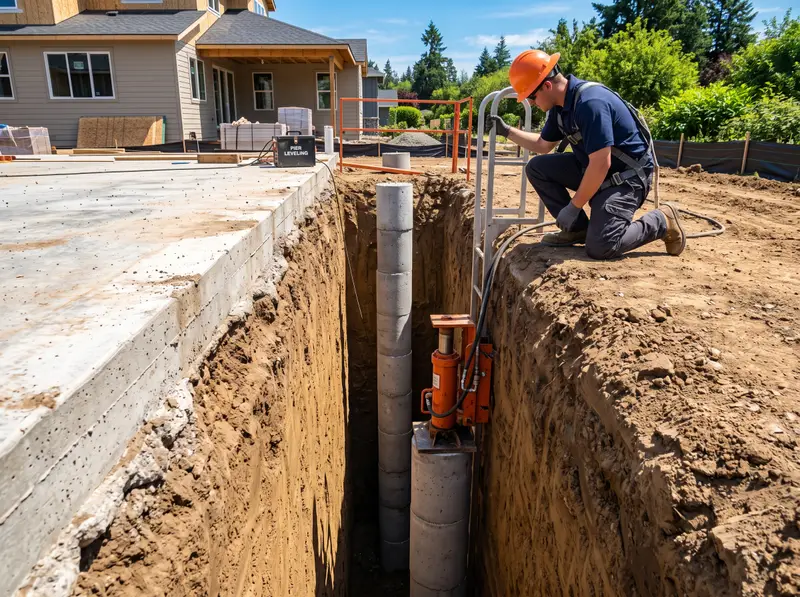
Support is installed down to ground that will carry the house, the weight of the structure is transferred onto it, and the house is raised toward its original elevation as far as it will safely go.
How deep support has to reach under Phoenix
Support has to bear on ground that will carry the house. Across 642,867 housing units built, at the median, in 1984, that depth is a measurement for each house rather than a figure for the city. It is established during installation — by driving to refusal, or by boring to a specified stratum — which is what makes it the single largest unknown in any quote written beforehand.
The reasoning behind that
It starts with the survey, because the pier count and their locations come from where the structure has moved rather than from a rule. Skipping this step is how a house gets somebody’s standard scope. Then access. Perimeter points are excavated from outside; interior points mean opening the floor. Support is driven, bored or turned down to competent ground — driven piles reach refusal using the weight of the house itself, bored piers go to a designed depth and need cure time. Then the transfer and the lift. Jacks take the load onto the new support and the structure is raised in small increments across several points at once, watched for how the building responds. This is where the judgment sits: how far to go is decided by the house, not by the survey. Finally backfill, patching, and — where it was in the scope — the plumbing test. Grading and gutter work that carries water away from the slab is a separate operation and is commonly a separate quote, which is why it is commonly not done.
Every question, in one place: Phoenix Foundation Repair Co questions.
Check the Phoenix Foundation Repair Co service area to see whether your street is covered.
Back to Phoenix Foundation Repair Co.