
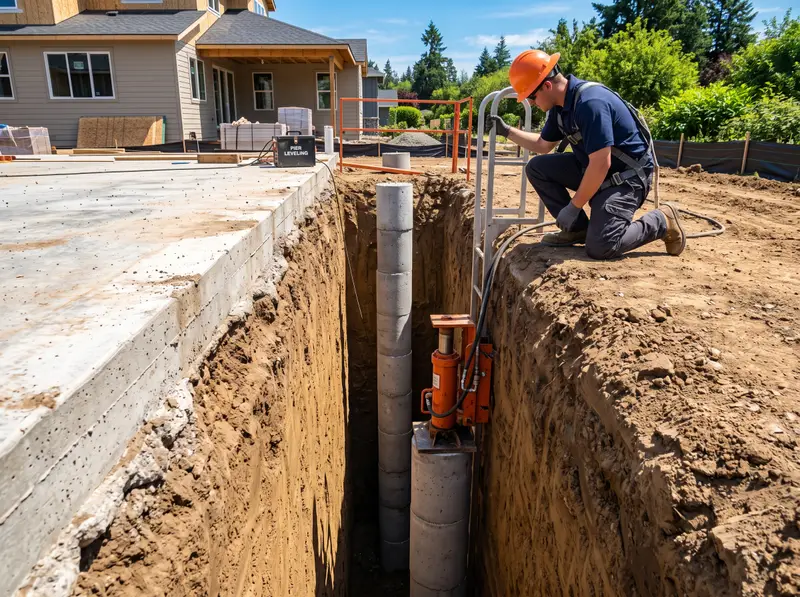
Piers bear on ground that will carry the house, so the support itself is not the thing with a lifespan. What decides whether the house moves again is whether whatever moved it the first time was found and addressed, and a second reading after the work is how you know.
What a second reading in Phoenix is for
An ordinary two-year storm drops 1.5 inches in a day here, and the median house was built in 1984. Support reaches ground that will carry the house; the rest of the slab rests where it rested before. A reading taken a season after the work, set against the one taken before it, is what shows whether the untouched part of the house has stopped, and roof water carried well clear of the slab keeps that comparison clean.
The reasoning behind that
A pier is a column bearing on competent ground. Steel and concrete in soil are not what fails. What fails is the assumption that the rest of the house is now stable, when whatever moved it in the first place was never identified and may still be at work on the parts that were never supported. This is why partial work sometimes produces new symptoms. Supporting one side of a structure while the other side keeps moving can increase the difference between them, which is the thing that cracks walls. The durable outcome comes from pairing the two: support where the movement has already happened, and a second set of readings a season later to show whether the rest of the house has stopped. Gutters and grading that carry roof water away from the slab are the cheapest addition to that pairing and the most frequently skipped. Warranties in this trade are commonly written against the installed support rather than against the house staying level. Read which one is being offered, because they are very different promises.
Every question, in one place: Phoenix Foundation Repair Co questions.
Check the Phoenix Foundation Repair Co service area to see whether your street is covered.
Back to Phoenix Foundation Repair Co.